
Abstract
The work presents parametric models for high-frequency common- and differential-mode impedance analysis of electrical machines. The models are presented in terms of lumped equivalent circuit diagrams and their corresponding complex impedance equations. In order to parameterize the models, the differential evolution algorithm is used and a minimization problem is defined. For model validation, the complex model impedance is compared to the measured impedance of eleven electrical machines of the same type. Furthermore, the lumped equivalent circuit parameters are individually identified for every single electrical machine and the resulting data is statistically interpreted. Moreover, detailed geometry and stator winding data as well as insulation material data of the investigated electrical machine are given. The intention is to enable more accurate simulations for EMC and insulation stress investigations as well as for filter and inverter designs.
Conclusion
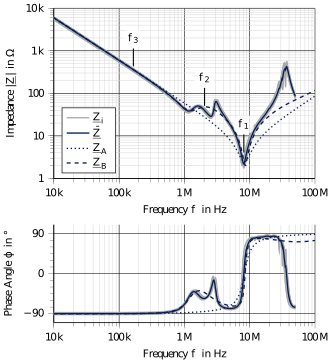
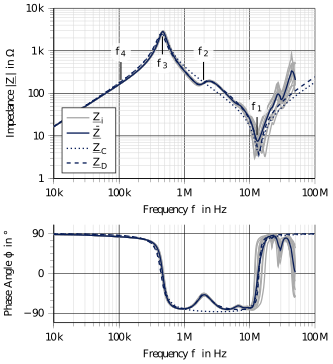
The identification of model parameters from measured impedance vs. frequency curves using the differential evolution algorithm showed good agreement for all models up to 30 MHz. To provide a good correlation above this point, further model extensions are required. As stated, this might be needed if rise times decrease further in the future or if higher model fidelity is needed in general. Parameter deviations are within acceptable limits for most of the parameters. Further studies on the time-domain behavior under consideration of parameter deviations are of great interest. As stated, accurate models enable improved disturbance investigations as well as better tuned filter and inverter designs. Furthermore, the presented procedure is applicable to linear motors such as presented in.